Buy 4 packs of seeds (or more) and get a 10% discount

a Piece of Nature
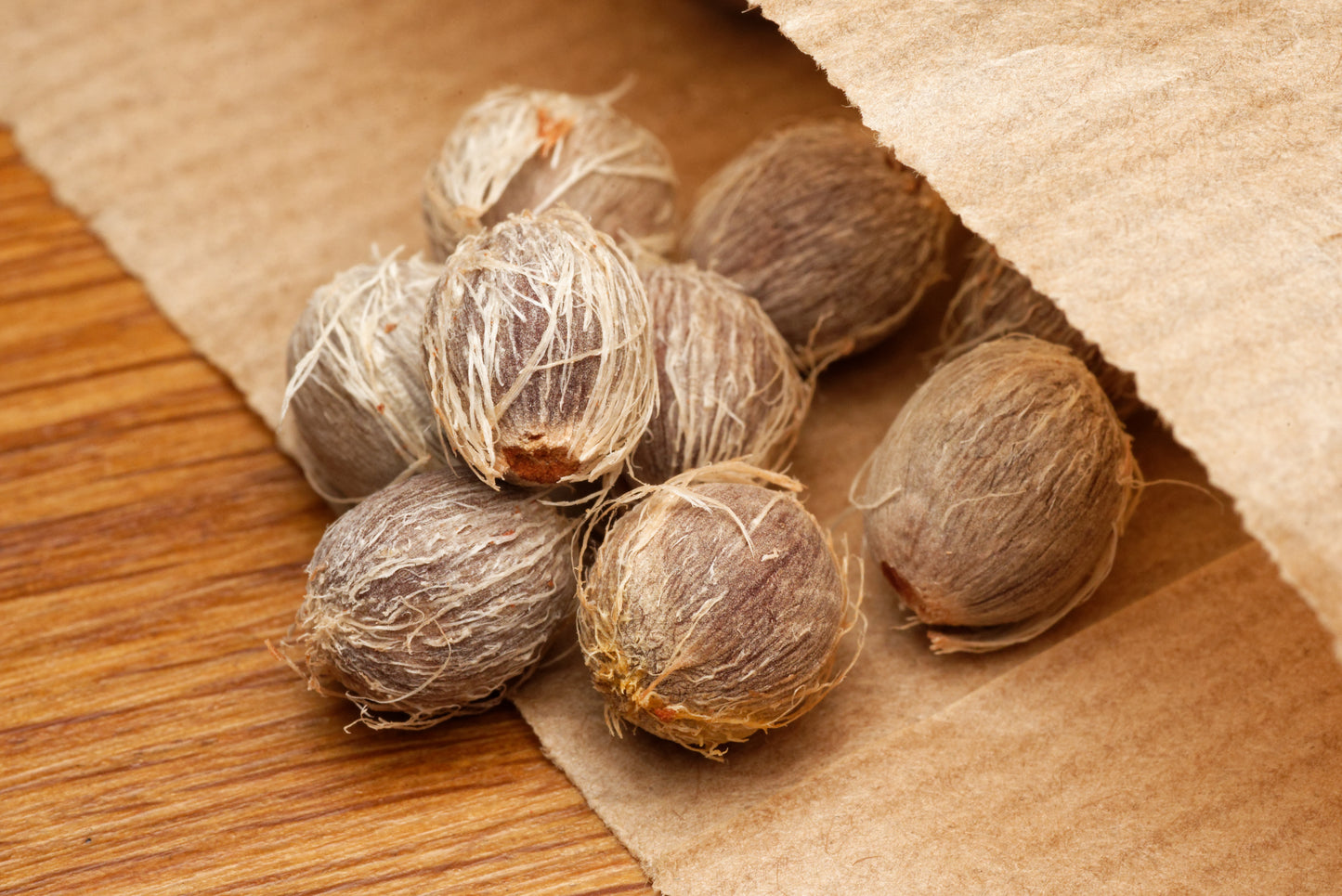
European fan palm (Chamaerops humilis) | seeds, 10 pcs.
European fan palm (Chamaerops humilis) | seeds, 10 pcs.
Couldn't load pickup availability
- Latin name: Chamaerops humilis
- Danish names: Europæisk dværgpalme, middelhavsdværgpalme
- English names: European fan palm, Mediterranean fan palm, Dwarf fan palm
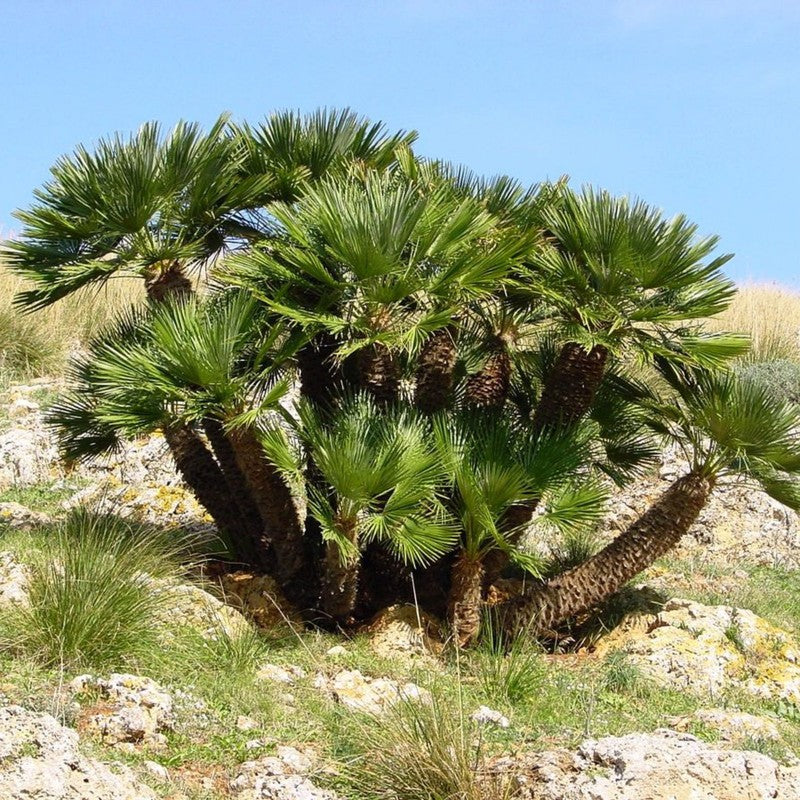
Chamaerops humilis is a compact and robust fan palm from the Mediterranean region and one of the very few palm species that occur naturally in Europe. It typically forms several trunks from the base and eventually develops a dense cluster of fan-shaped leaves, giving it a bushier and more compact appearance than many single-trunked palms.
The species is native to the western and central Mediterranean region, including Southern Europe and North Africa. Here, it grows in Mediterranean scrubland, on rocky slopes, and in other sunny, dry habitats. It is adapted to hot summers, periods of drought, strong sun, and relatively nutrient-poor soils.
Chamaerops humilis usually grows to about 2–4 meters in height, but very old specimens can become larger. The plant naturally forms side shoots from the base, so a single plant can eventually develop into a broad cluster with many trunks. If a more single-trunked appearance is desired, these side shoots can be removed regularly.
The stiff, fan-shaped leaves vary from fresh green to grey-green and are divided into numerous narrow segments. The leaf stalks are armed with sharp thorns along the edges, which is worth noting when handling and placing the plant.
A special variety is Chamaerops humilis var. cerifera, which originates from the Atlas Mountains in North Africa. It is distinguished primarily by its striking silvery-blue to blue-grey leaves, while the common Chamaerops humilis typically has greener foliage. Both share the characteristic compact, multi-stemmed growth and are interesting palms for sunny and relatively dry locations.
If you are interested in more fan palms and other exciting palm species, you can explore our entire selection of palm seeds.
Cultivation and requirements
Chamaerops humilis is a robust palm that thrives best with plenty of light, warmth, and good drainage. It prefers:
- Full sun or a very bright location
- A well-drained, preferably sandy or mineral-rich soil
- Regular watering during active growth, allowing it to dry out between waterings
- A warm and preferably sheltered location
- Limited watering during the cooler part of the year
Established plants are relatively drought-tolerant, but regular watering and fertilizer during the growing season result in faster and more vigorous growth. Especially when grown in containers, good drainage is important, as the combination of low temperatures and constantly wet soil can be problematic in winter.
The species is among the more cold-tolerant palms and can withstand short-term frost of around -10 °C or slightly lower under favorable conditions. However, the leaves can be damaged at higher temperatures, and young plants are significantly more sensitive. In Denmark, cultivation in containers with protected overwintering is the safest solution, but on warm and well-drained sites, larger plants may also be planted outdoors with winter protection.
Growing from seeds
Seeds of Chamaerops humilis are relatively easy to work with and germinate best under warm and evenly moist conditions. It is recommended to soak the seeds in lukewarm water for 24–48 hours before sowing.
- Sow in an airy and well-drained seed compost (alternatively, the baggie method can be used)
- Cover the seeds with about 1 cm of sowing medium
- Keep the temperature around 22–28 °C
- Keep the medium lightly and evenly moist, but not wet
- The seeds do not require cold stratification
Under good conditions, the first seeds may germinate after a few weeks, but germination can be irregular and continue over several months. You should therefore not discard the sowing if individual seeds take longer to germinate.
Young plants first develop narrow and relatively simple leaves. The characteristic fan leaves emerge gradually as the plant grows. Our tall palm pots are well-suited for further cultivation and provide plenty of room for root development.
- You may also want to see our article on germinating palm seeds.
Utility and collector value
Chamaerops humilis is botanically interesting as one of the very few palms naturally native to the European mainland. It is a characteristic part of the vegetation in parts of the western Mediterranean, where it can form dense thickets in warm and dry locations.
The palm has also had practical significance around the Mediterranean. Leaf fibers and leaves have traditionally been used for baskets, mats, brooms, and other woven products, while the plant's main use today is as an ornamental plant.
For the palm collector, the species combines several attractive properties. It remains relatively compact, tolerates both strong sun and periods of drought, and has significantly better cold tolerance than most tropical palms. The multi-stemmed growth also gives the plant a dense and lush appearance, even without a tall trunk.
Along with the bluish Chamaerops humilis var. cerifera, it is also interesting as an example of natural variation within the species. While the common form provides a classic green Mediterranean look, var. cerifera adds a more silver-blue touch.
Chamaerops humilis is therefore an obvious choice for both beginners and experienced palm enthusiasts who want a robust, compact, and characterful fan palm with the possibility of spending a large part of the year outdoors in Denmark. Also, see our entire selection of seeds of hardy plants.
Seed germination
Seed germination
Childcare
Childcare
Size
Size
6 meters
Difficulty level
Difficulty level
Beginner
NB
NB