Buy 4 packs of seeds (or more) and get a 10% discount


a Piece of Nature
Giant Himalayan Lily (Cardiocrinum giganteum) | seeds, 10 pcs.
Giant Himalayan Lily (Cardiocrinum giganteum) | seeds, 10 pcs.
Couldn't load pickup availability
HARDY | REQUIRES SHADE AND MOIST SOIL
- Latin name: Cardiocrinum giganteum
-
Danish names: Kæmpehjertelilje
-
English names: Giant Himalayan lily, giant heart lily
Cardiocrinum giganteum, also known as the giant Himalayan lily, is a spectacular and monumental bulbous plant native to the shaded forests of the Himalayas, China, and Myanmar. It is the largest of all lily-like plants and is known for its impressive flowering and dramatic presence in woodland gardens and semi-shaded beds.
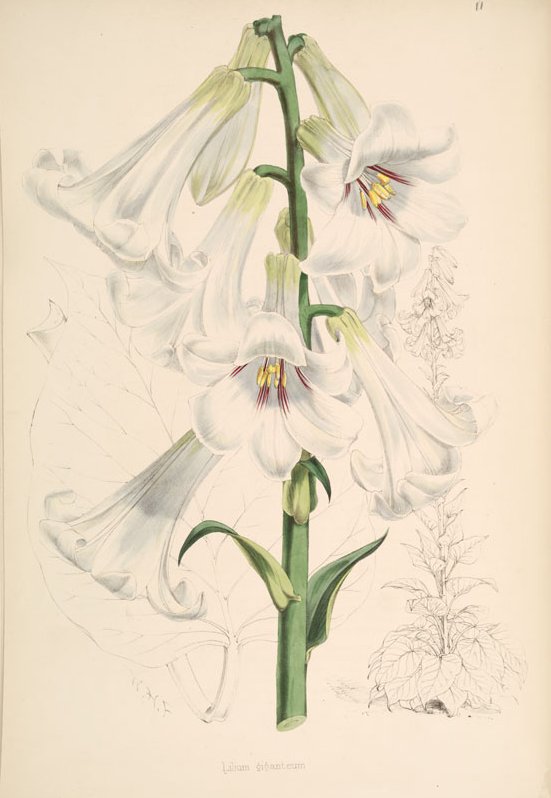
The plant grows from a large, perennial bulb that, over several years, builds up energy for a single, giant bloom. When it is ready, it sends up a stalk up to 2–3 meters tall, crowned by large, trumpet-shaped flowers in white with purple stripes and green tinges. The flowers are slightly fragrant and appear in June–August, depending on the climate and location.
The large, heart-shaped leaves form a basal rosette that provides lush green volume long before the plant blooms. After flowering, the main bulb dies, but it usually produces offsets (bulbils) that can develop into new plants over the following years.
Cardiocrinum giganteum thrives best in semi-shade to shade and requires deep, humus-rich, moisture-retentive, yet well-drained soil. It prefers a cool, protected location – ideally in a woodland-style bed or a north-facing corner. The plant is fully hardy in Denmark and survives the winter well, as long as the soil does not become waterlogged.
Cultivation from seed:
Cultivation from seed requires patience, as the plant has a slow development. Seeds should be sown shallowly in moist, well-drained seed compost and must not dry out. They require a cold period (stratification) of several weeks – typically they are sown in autumn and placed outdoors or in a refrigerator for 6–8 weeks at approx. 4 °C. Afterwards, they are moved to room temperature, where germination can occur gradually – often over several months.
Seedlings typically take 4–7 years to develop into flowering specimens, but the impressive display makes the wait worthwhile.
Utility and use:
Cardiocrinum giganteum is primarily grown as an ornamental plant in shady gardens, where its size and dramatic flowering create a botanical highlight. In its homeland, the plant has had some ethnobotanical significance – among other things, parts of the plant have been used in traditional medicine and as food in emergency situations, but today it is primarily a highly prized collector's plant in the gardening world.
This species is ideal for the patient gardener who wants something special, magnificent, and almost fairytale-like in the garden. Cardiocrinum giganteum combines the tranquility of the forest floor with a tropical splendor – a true showstopper when it finally blooms.
Seed germination
Seed germination
Childcare
Childcare
Size
Size
Up to 3 meters
Difficulty level
Difficulty level
Between
NB
NB
The seeds are already stratified.